
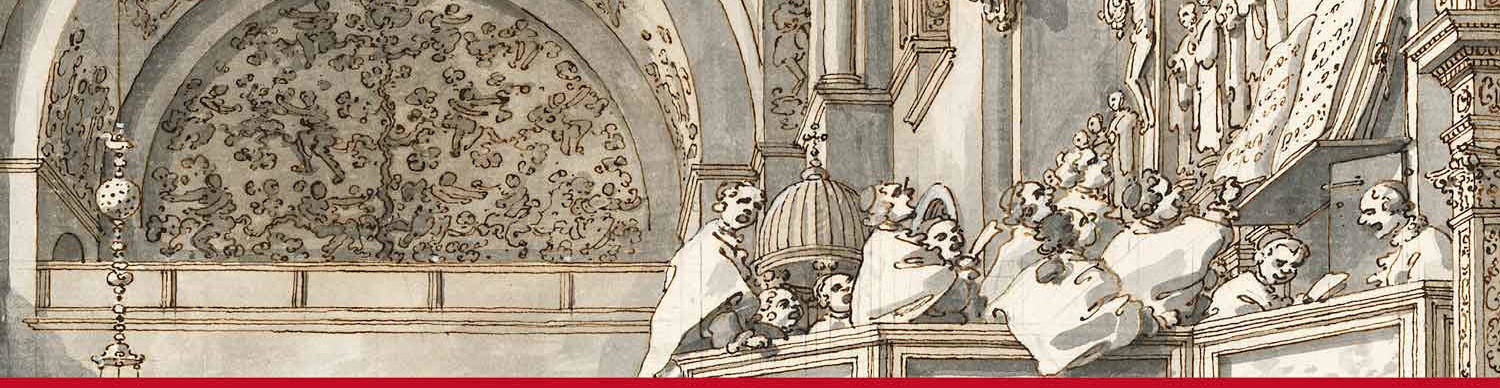

Bild: © Kunsthalle Hamburg
Tagungen
Sacred Sound in Transit
Musical Practice, Spatial Transfer and Local Adaptation in Early Modern Europe
Mainz, 17–18 December 2026
International and Interdisciplinary Workshop
Johannes Gutenberg University Mainz
Institute for Art History and Musicology, Department of Musicology
Research Project CANTORIA – Music and Sacred Architecture
Concept and Organisation
Margherita Antolini, Klaus Pietschmann and
Tobias C. Weißmann
Conference Venues
Johannes Gutenberg University Mainz
Episcopal Seminary of St Boniface
Mainz Cathedral

In the seventeenth and early eighteenth centuries, new forms of sacred music circulated across Europe together with musicians, repertories, instruments and ideas about performance. Changes in musical style and ensemble size affected the spatial disposition of performers and thus the relationship between music, architecture, acoustics and liturgy. In Rome, polychoral performance practices made extensive use of permanent cantorie and coretti as well as temporary palchi, while the increasing importance of pratica concertata introduced changing requirements for the positioning and accommodation of singers and instrumentalists. Yet such developments cannot be understood as the simple diffusion of a single Roman model. Venetian polychorality, Roman concertato practices and other Italian traditions intersected with local musical, architectural and confessional cultures north of the Alps.
The interdisciplinary workshop, which will take place at Johannes Gutenberg University Mainz in December 2026, focuses on the transfer and spatial translation of sacred musical practices between Italy and Central Europe. Rather than asking only how repertories circulated, we investigate what happened when particular performance practices entered new architectural, institutional and liturgical environments. Special attention will be given to the Rhine-Main region and neighbouring ecclesiastical territories, including Mainz, Würzburg, Frankfurt, Cologne/Bonn and Fulda, which provide particularly promising case studies for different forms of musical and spatial adaptation. These Catholic contexts will be considered in comparison with better-researched Protestant centres such as Wolfenbüttel and Dresden. Guiding questions could be: What exactly was transferred – repertory, scoring practices, ensemble structures, spatial dispositions, acoustic knowledge or architectural solutions? Who acted as mediators: travelling musicians, court chapels, religious orders, ecclesiastical princes, architects, organ builders, printers or institutional networks? How can direct transfer be distinguished from mediated adaptation or independent parallel development? To what extent did imported musical practices require temporary stages, galleries, organs or more permanent architectural interventions? And how can 3D reconstruction and acoustic simulation contribute to reconstructing such ephemeral and often poorly documented performance situations?
The workshop brings together approaches from musicology, architectural and art history, liturgical history, transfer and mobility studies, acoustics and Digital Humanities. Its aim is to develop a shared methodology for a comparative history of musical-spatial transfer and to identify promising case studies, sources and archival holdings for future international cooperation. The workshop is organised by the research project „CANTORIA – Music and Sacred Architecture“ at Johannes Gutenberg University Mainz.
Thursday, 17 December 2026
Venue: Johannes Gutenberg University Mainz, Faculty Hall (Fakultätssaal), Philosophicum I, Room 01 185, Jakob-Welder-Weg 18, 55128 Mainz
14.30: Klaus Pietschmann | Tobias C. Weißmann (Mainz): Welcome and Introduction
I. Italian Practices. Space, Sound and Meaning
Chair: Lamberto Tronchin (Bologna)
15.00: Margherita Antolini (Rome): The Agency of Performance Practice in Baroque Architectural Design
15.45: Coffee Break
16.15: Maryam Haiawi (Regensburg): Die Imitation von Engelsmusik im intermedialen Wechselspiel von Musik, Text und Kirchenraum. Orazio Benevolis sechschörige Vespermusik Laudate pueri Dominum für das Patronatsfest im Petersdom 1650
17.00: Haruna Saito (Bologna): Liturgical Music Performance in Seventeenth-Century Bologna. An Acoustical and Historical Study of Selected Churches
Friday, 18 December 2026
Venue: Bischöfliches Priesterseminar St. Bonifatius (Episcopal Seminary of St Boniface), Assembly Hall (Aula), Augustinerstraße 34, 55116 Mainz
II. Transfer and Adaptation North of the Alps
Chair: Klaus Pietschmann (Mainz)
10:00 Amalia Salvestrini (Milan): Depth and Motion in the Sonic Sphere. An Aesthetic-Phenomenological Contribution on Lodovico da Viadana, Heinrich Schütz and Michael Praetorius
10.45: Simon Paulus (Stuttgart): Ein vergessener Klangraum. Neue Erkenntnisse (und Fragen) zur Wolfenbütteler Schlosskapelle und ihrer architektonischen und musikalischen Konzeption im 17. Jahrhundert
Venue: Mainz Cathedral (Hoher Dom St. Martin), Markt 10, 55116 Mainz
12.00: Organ Recital in Mainz Cathedral – Daniel Beckmann (Mainz)
12.45: Lunch Break (Old Town)
II. Transfer and Adaptation North of the Alps (continued)
Venue: Bischöfliches Priesterseminar St. Bonifatius (Episcopal Seminary of St Boniface), Assembly Hall (Aula), Augustinerstraße 34, 55116 Mainz
Chair: Tobias C. Weißmann (Mainz)
15.30: Florian Bassani (Bern): Die Festmusik zum Nürnberger Friedensmahl von 1649 – aus italienischer Perspektive betrachtet
16.15: Gareth James (Birmingham): Bespoke or Borrowed? Pietro Torri’s 1726 Requiem for Max Emanuel between Munich and Brussels
17.00: Coffee Break
III. Digital Reconstruction and Acoustic Simulation
Chair: Margherita Antolini (Rome)
17.15: Miguel Reis Vasco (Lisbon): Hearing the Sacred Oval Space. From Laser Scanning to Acoustic Simulation of the Clérigos Church in Porto
18.00: Final Discussion
Zurückliegende Tagungen
Empty Boxes?
Modeling the Lost and Ephemeral in Premodern Sacred Spaces
Rom, 29.–30. Mai 2025
Weitere Informationen inkl. Programm und Abstracts sind auf dieser Webseite verfügbar.
Aural Architectures of the Divine.
Sacred Spaces, Sound and Rites in Transcultural Perspectives
Florenz, 24.–26. Februar 2022
→ Informationen auf deutsch, inkl. Programm und Abstracts sind auf dieser Webseite hier verfügbar.
Sakralarchitektur, Ritus und Musik zwischen Byzanz und dem Westen (6.–15. Jahrhundert) |
Sacred Architecture, Rite and Music between Byzantium and the West (Sixth to Fifteenth Century)
21.–23. Januar 2021 | 21–23 January 2021
→ Informationen auf deutsch, inkl. Programm und Abstracts sind auf dieser Webseite hier verfügbar.
„Music, Performance, Architecture. Sacred Spaces as Sound Spaces in the Early Modern Period”
International and Interdisciplinary Conference
→ see separate conference page
Rome/Vatican City, 11–14 December 2019
Concept and scientific organisation
Klaus Pietschmann and Tobias C. Weißmann (Johannes Gutenberg University Mainz)
German Historical Intitute in Rome, Department of Music History
Conference venues
German Historical Institute in Rome
Biblioteca Vallicelliana
Biblioteca Apostolica Vatican
S. Maria in Vallicella
Apostolic Palace